

If you’re an employer, leader or HR professional right now, chances are psychosocial risk management feels… a bit overwhelming.
The Code of Practice calls out 14 different psychosocial hazard areas that employers are expected to identify, assess and manage. On paper, it’s thorough. In real life, it can feel like another long list added to an already full plate.
The good news?
You don’t need to tackle all 14 hazards individually to make meaningful progress.
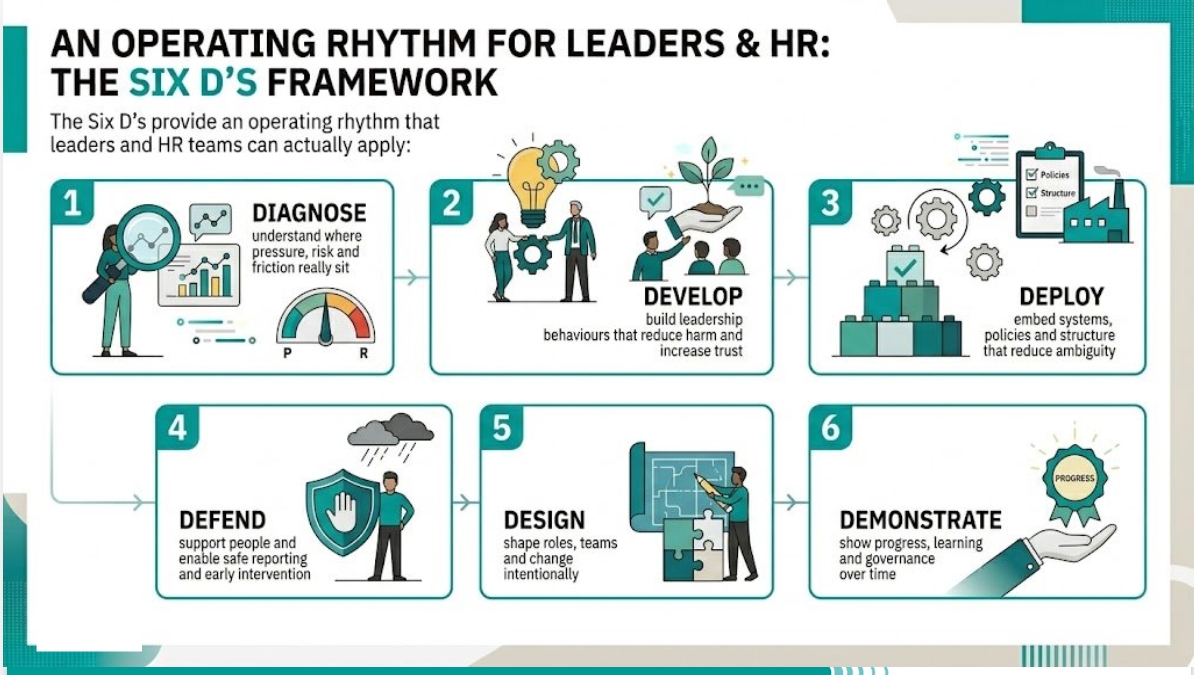
In practice, we’ve found they can be simplified into five clear focus areas — what we call the 6 D’s. When done well, they don’t just support compliance… they actively build healthier culture, stronger leadership and better performance.
And importantly: you don’t have to be perfect to start.
First, a bit of empathy
Most organisations aren’t ignoring psychosocial risk because they don’t care. They’re stuck because:
- They’re busy
- They’re dealing with competing priorities
- They’re not quite sure where the real risks actually sit
- Or they’re worried about “opening a can of worms
That’s normal. But there are also some that have their head in the sand.
Which is why the first step isn’t fixing everything, it’s simply getting a clear, honest picture of where you’re at.
The 6 D’s explained
1. Diagnose the risk
This is the foundation.
Before you design programs, roll out training or rewrite policies, you need a reality check. Not assumptions. Not anecdotes. Actual data.
- Where psychosocial risks are emerging
- Which teams or roles are under the most pressure
- Whether leadership behaviours are helping or hindering
- How safe people feel speaking up
This is where tools like psychosocial risk audits, HR audits, culture surveys, pulse surveys and 360s come in. Also a good first step is completing a psychosocial risk assessment process.
Think of Diagnose as asking:
“What’s really going on here, not what we hope is happening or we assume is happening?”
Without this step, everything else is guesswork.
2. Develop the leader
Most psychosocial risks are experienced through leadership, even when they’re caused by systems or workload.
Job demands, role clarity, support, recognition, change, conflict, they all land in a leader’s inbox, this is whilst they are using 33% of their time dealing with interpersonal issues amongst their employees.
Developing good leaders means building:
- Emotional regulation under pressure
- Confidence in difficult conversations
- Skills to lead change without burning people out
- Awareness of how behaviour impacts psychological safety
This isn’t about “soft skills”.
It’s about capability that holds when things get hard.
When leaders change their behaviour, risk reduces — and culture improves.
3. Deploy the systems
Good intentions fall over without good systems.
Many psychosocial risks are amplified by:
- Unclear processes
- Inconsistent decision-making
- Poor role design
- Outdated, unused policies or even worse policies that are not adhered to
- Manual, fragmented HR processes.
Deploying the right systems means:
- Clear, consistent HR foundations
- Enterprise-grade recruitment, onboarding, performance, compliance and learning systems
- Policies and procedures that are tailored, usable, current and defensible
Systems reduce ambiguity, and ambiguity is one of the biggest drivers of stress at work.
4. Defend the people
No matter how good your culture is, issues will still arise.
What matters is whether people feel safe enough to:
- Ask for help early
- Speak up about concerns
- Report inappropriate behaviour
- Access support without fear
This is where Employee Assistance Programs, anonymous Speak Up / whistleblower tools, and fair, independent response processes are critical.
Defending the people isn’t about expecting the worst.
It’s about building trust before something goes wrong and having things in place if they do.
5. Design the future
The final D is where culture really comes to life.
Design focuses on:
- Job design that’s meaningful and sustainable
- Clear, defensible job descriptions
- Team workshops that align mission, vision and values
- Design thinking and process improvement
- Change readiness — bringing people with you, not dragging them along
Many psychosocial risks don’t come from “bad people”, they come from poorly designed work.
Designing work well reduces risk and lifts engagement and productivity.
6. Demonstrate over time
This is the piece that turns intention into evidence.
Psychosocial safety isn’t a one-off project — it’s something organisations must be able to demonstrate over time.
That means:
- Annual psychosocial risk audits and reviews
- Regular pulse checks to monitor workload, stress, safety and change fatigue
- Ongoing risk assessments, especially during periods of change
- Refresher and targeted training, not just one-and-done sessions
- Reviewing incidents, themes and data trends — and acting on them
Demonstrating isn’t about creating paperwork for the sake of it.
It’s about showing:
- You are actively monitoring risk
- You are adjusting as the organisation changes
- You are meeting your duty of care in a visible, defensible way
This is where compliance, assurance and culture maturity intersect.
So where do the 14 psychosocial risks fit?
The 14 hazard areas in the Code of Practice (things like job demands, low control, poor support, conflict, harassment, change, remote work, etc.) are all addressed within these five actions.
You don’t need 14 separate projects.
By focusing on:
- Diagnosing reality
- Developing leadership behaviour
- Deploying strong systems
- Defending people through support and safe reporting
- Designing work and change intentionally
- Demonstrate over time
…and by taking practical actions across these areas (not all at once), most organisations get a strong, defensible kickstart toward both compliance and culture improvement.
If you’re not sure where to start…
Start with Diagnose.
A psychosocial risk audit gives you a clear baseline, confidence about where the real risks are, a practical roadmap instead of a value obligation, and a way to prioritise effort where it will actually make a difference.
It’s not about judgment.
It’s about clarity.
Because once you know where you’re at, everything else becomes easier.